Tuesday, January 31, 2006

mall-like airport and the flight from hell

Mall or Airport? Well, i must say both. Changi Airport is one awesome airport. It's huge. It's gleaming. And it's packed with people from all corners of the globe. There's this group of Texans who were completely astounded by Changi's size that they were reduced to saying "Man, this is fucking big."

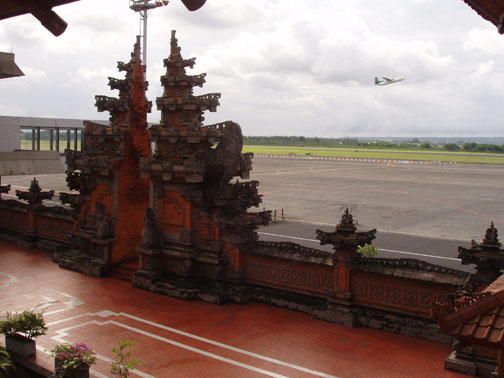
Like Soekarno-Hatta Jakarta International Airport, the international airport in Bali is Asian-inspired in its design and architecture. The first thing you will hear upon arrival is the enchanting Balinese classical music being played throughout the whole terminal. It's like setting foot in a Hindu temple. Very relaxing.


On board Merpati Airlines from Denpasar to Dili in East Timor. The plane was ancient and rusty. It was clearly showing its age. The tray in front of my seat was broken, I requested to be transferred to another seat. Boy, I have never been so scared in my entire life. When the flight crew started to demonstrate the safety features of the aircraft I watched and listened carefully. I checked the life vest, the oxygen mask and scolded a teenaged girl when she attempted to open her mobile phone! Barely-stifled screams ripped out of my throat when we encountered air pockets. I even made the sign of the cross twenty times during the first 30 minutes of the flight! Looking around, I noticed fear and anxiety in the faces of my co-passengers. Even the flight attendants themselves seemed to be not too happy being in that airplane. I decided to get hold of myself and ordered several glasses of wine. Fifteen minutes before the plane landed the fear was gone and I was smiling like a fool. Obviously, I was again happily stewed! Hehehe.

Wednesday, January 25, 2006

East Timor trip

23 January 2006

Manila to Bali via Singapore

Our flight from Manila to Singapore was uneventful. Nothing creepy happened. As usual, Singapore Airlines lived up to its reputation as one of the world’s best airlines. The flight service was excellent although the crew was too cheerful. Their smiles were so sunshiny I almost got blinded. I even tried to restrain myself from touching their faces so I could find out if they were real!

The inflight food was average. You have a choice of honey-glazed chicken with mashed potatoes and fruit salad or Escabeche! Yes, the pinoy escabeche. I tried the chicken and washed it down with three glasses of red wine. Midway to our flight I was pretty smashed! It is a good thing to get drunk when you’re flying especially if the one sitting next to you smells like a dead rat!

We have a two-hour layover at the Changi Airport. Now, this is some airport! It’s like a mall, a ritzy big freaking mall. There are shops and restaurants everywhere. You can get anything you want here if you have tons of money. Last year I bought my copy of Nobody Knows and The Kite Runner in TimeLinks Asia.

In our connecting flight to Bali, I was mistaken for an Indonesian. The guy next to me kept on yakking in Bahasa until I said shove it! He looked at me, blinked and then he shut his trap. Hehehe. We arrived in Bali at around 10 pm. From the airport it was 30 minutes to All Seasons Hotel, our home for the night. The next day we would fly to the newest democracy in the planet, East Timor. I threw my things on the floor and jumped into bed. Sixty seconds later I lost consciousness.


24 January 2006

Bali to Dili in East Timor

I woke up in this paradise island called Bali at around 6:30 in the morning. My room is about 60 dollars a night with free breakfast. Not bad considering the hotel room rates in the Bali guidebook that Singapore Airlines gave to us starts from 120 dollars. I had a view of the pool and a veranda plus a king-sized bed. The only thing that worries me is that my hotel is located in the area favored by bomb-throwing loonies. In October last year scores of people were killed in a terror attack here. That was the second bombing in just three years. Bali, though, is still a westerners’ playground. I haven’t seen so much white people in my entire life! They’re everywhere, parang kabute!

Thursday, January 19, 2006

bad, bad Bush

Bush: Man or Chimp?
(Photo from Why We Hate Bush?)


2005 was arguably the year human rights took a severe beating all over the world. And there is only one guy to blame, George 'Dubya' Bush. His policies in the US and overseas completely trashed the concept of respecting human rights.

The motto of the year seemed to be: "If America, the bastion of democracy, can beat the crap out of the prisoners in Abu Ghraib and Guantanamo Bay, then why the hell can't we."

According to a report from Human Rights Watch," evidence showed that abusive interrogation cannot be reduced to the misdeeds of a few low-ranking soldiers, but was a conscious policy choice by senior U.S. government officials. The policy has hampered Washington’s ability to cajole or pressure other states into respecting international law."

Let us count the number of times the US pooh-poohed human rights:
1. the torture in Abu Ghraib
2. the abusive interrogation in Guantanamo facility
3. the so called 'CIA Flights'
4. the illegal wiretapping including electronic surveillance of its own citizens

The list goes on and on. However, the US is not alone in accumulating points in human rights abuses department. The same Human Rights Watch report went on to enumerate abuses in other parts of the globe: the ethnic cleansing in Darfur; repression in Burma, Tibet, Turkmenistan, Vietnam and Syria; and the massive, politically motivated evictions of informal settlers in Harare in Zimbabwe. However, the New York based human rights watchdog failed to include the situations in Thailand and in the Philippines.

For some time now, media practitioners in Thailand have been under severe government restriction. They are victims of harrassment, courtesy of Thaksin 'The Sore Loser' Shinawatra. Journalists, editors and activists agreed that the trend in the Buddhist kingdom leans towards less press freedom. Just ask Supinya Klangnarong, the poster girl for the Thai government's repression against the media. A writer and freedom of speech activist, Supinya has been sued for libel by Shin Corporation, which is owned by Thaksin's family. According to the Thai Press Council, the number of criminal defamation suits filed against journalists had more than doubled compared to the number filed in 2004.

Here in the Philippines, goons and politicians (aren't they the same?) do not file criminal charges against the media; they just shoot them in the head or bury them alive. Sometimes they accuse the media of harboring terrorists which gives them license to haul them off to jail. No lawsuits, no hassles. Just plain political thuggery. Isn't that much simpler?

Then we have calibrated pre-emptive response, GMA's own little version of Bush's pre-emptive strike. Suddenly, no more maximum tolerance for the pesky rallyists. If the authorities are not busy bashing the heads of the activists into pieces then they are 'cannonizing' them with water. Last year, the police really had a field day beating the hell out of the protesters.

In 2005, human rights was the sacrificial lamb in the altars of power-hungry despots and Dubya's war on terrorism. I hope this year will be better for human rights. Sana.

Tuesday, January 17, 2006

Stop the war in Iraq

Before the US invasion of Iraq in 2003 I was working with the Center for Asia Pacific Women in Politics as Content Manager of its website and e-bulletin. The e-bulletin, OnlineWomen, has more than 3000 subscribers from all over the world most of whom are Women in Politics (WIP) advocates, academics and researchers.

At the height of the debate in the UN Security Council over actions to be taken against Iraq I included a War in Iraq Q & A in the OnlineWomen bulletin. I forgot who authored this Q & A but I recall that it was also featured in Conrado De Quiros' column in the Inquirer. It became one of the most popular and controversial items in the e-bulletin.
Take the War in Iraq Q & A

Q: What percentage of the world's population does the United States have?
A: Six percent

Q: What percentage of the world's wealth does the United States have?
A: 50 percent

Q: Which country has the largest oil reserves?
A: Saudi Arabia

Q: Which country has the second largest oil reserves?
A: Iraq

Q: How much is spent on military budgets a year worldwide?
A: 900+ billion dollars

Q: How much of this is spent by the United States?
A: 50 percent

Q: What percent of US military spending would ensure the essentials of life to everyone in the world, according to the United Nations?
A: 10 percent (that's about 40 billion dollars, the amount of funding initially requested to fund the US retaliatory attack on Afghanistan).

Q: How many people have died in wars since World War II?
A: 86 million

Q: How long has Iraq had chemical and biological weapons?
A: Since the early 1980s.

Q: Did Iraq develop these chemical and biological weapons on its own?
A: No, the materials and technology were supplied by the US government, along with Britain and private corporations.

Q: Did the US government condemn the Iraqi use of gas warfare against Iran?
A: No

Q: How many people did Saddam Hussein kill using gas in the Kurdish town of Halabja in 1988?
A: 5,000

Q: How many Western countries condemned this action at the time?
A: 0

Q: How many gallons of Agent Orange did America use in Vietnam?
A: 17 million.

Q: Are there any proven links between Iraq and Sept. 11 terrorist attack?
A: No

Q: What is the estimated number of civilian casualties in the Gulf War?
A: 35,000

Q: How many casualties did the Iraqi military inflict on the Western forces during the Gulf War?
A: 0

Q: How many retreating Iraqi soldiers were buried alive by US tanks with ploughs mounted on the front?
A: 6,000

Q: How many tons of depleted uranium were left in Iraq and Kuwait after the Gulf War?
A: 40 tons

Q: What according to the UN was the increase in cancer rates in Iraq between 1991 and 1994?
A: 700 percent

Q: How much of Iraq's military capacity did America claim it had destroyed in 1991?
A: 80 percent

Q: Is there any proof that Iraq plans to use its weapons for anything other than deterrence and self-defense?
A: No

Q: Does Iraq present more of a threat to world peace now than 10 years ago?
A: No

Q: How many civilian deaths has the Pentagon predicted in the event of an attack on Iraq in 2002/3?
A: 10,000

Q: What percentage of these will be children?
A: Over 50 percent

Q: How many years has the US engaged in air strikes on Iraq?
A: 11 years

Q: Were the United States and the United Kingdom at war with Iraq between December 1998 and September 1999?
A: No

Q: How many pounds of explosives were dropped on Iraq between December 1998 and September 1999?
A: 20 million

Q: How many years ago was UN Resolution 661 introduced, imposing strict sanctions on Iraq's imports and exports?
A: 12 years

Q: What was the child death rate in Iraq in 1989 (per 1,000 births)?
A: 38

Q: What was the estimated child death rate in Iraq in 1999 (per 1,000 births)?
A: 131 (that's an increase of 345 percent)

Q: How many Iraqis are estimated to have died by October 1999 as a result of UN sanctions?
A: 1.5 million

Q: How many Iraqi children are estimated to have died due to sanctions since 1997?
A: 750,000

Q: Did Saddam order the inspectors out of Iraq?
A: No

Q: How many inspections were there in November and December 1998?
A: 300

Q: How many of these inspections had problems?
A: 5

Q: Were the weapons inspectors allowed entry to the Ba'ath Party HQ?
A: Yes

Q: Who said that by December 1998, "Iraq had in fact, been disarmed to a level unprecedented in modern history."
A: Scott Ritter, UNSCOM chief

Q: In 1998 how much of Iraq's post-1991 capacity to develop weapons of mass destruction did the UN weapons inspectors claim to have discovered and dismantled?
A: 90 percent

Q: Is Iraq willing to allow the weapons inspectors back in?
A: Yes

Q: How many UN resolutions did Israel violate by 1992?
A: Over 65

Q: How many UN resolutions on Israel did America veto between 1972 and 1990?
A: 30+

Q: How many countries are known to have nuclear weapons?
A: 8

Q: How many nuclear warheads has Iraq got?
A: 0

Q: How many nuclear warheads has the United States got?
A: Over 10,000

Q: Which is the only country to use nuclear weapons?
A: The United States

Q: How many nuclear warheads does Israel have?
A: Over 400

Q: Who said, "Our lives begin to end the day we become silent about things that matter"?
A: Dr. Martin Luther King Jr.
Three years after the invasion there is still no sign of weapons of mass destruction as alleged by Bush and his cohorts (Cheney, Rice, and his puppets in Congress). Documents revealed that Saddam Hussein, who is undeniably a tyrant, has no connections to Osama bin Laden. Al-Qaeda only made its presence in Iraq after the invasion where it has recruited frustrated and patriotic Iraqis. Clearly, the American people and the whole civilized world were tricked into this war by this Bible-wielding, cowboy hat-wearing Texan. Today, scores of people are being killed in Iraq everyday. The coutry is in utter chaos. Various tribes and religious groups are killing each other. Sunnis vs. the Shiites. Iraqis vs. the occupying forces. The worst part is, there seems to be no end in sight. It is time that the US withdraw its forces from Iraq.

If you think that the US should pull out from Iraq now then join activist/actress Susan Sarandon, the award-winning playwright Eve Ensler and thousands of other women from all around the globe in calling the attention of the Bush administration. Sign the women's call for peace. Men are most welcome to sign as well. They hope to gather a minimum of 100,000 signatures by International Women's Day on March 8, 2006, when US and Iraqi women will deliver these signatures to leaders in Washington DC and women around the world will deliver them to US embassies.

Freedom is for everyone.

(Photo from WhyWeHateBush.com)

Saturday, January 14, 2006

the country is on a twisted roll and my ass hurts

i went to the gym this morning. it's only my second day. my legs hurt and so are my arms. i can't even type a word in the freaking keyboard without screaming my head off. bloody hell.

when you're single and in you're thirties you start thinking about firming up those muscles and losing that awful flabs especially if you're a beer-drinking loser like me. so i decided to get my priorities straight. killer bod for the beach or upgrading my pc or learning a new language? i chose to buy me a new body. so, now i'll just paste dodo's summary of dr. habito's presentation on the country's situation:
I would like to share with you the highlights of the presentation of
Dr. Cielito Habito, former Director-General of the National Economic
and Development Authority (NEDA) and now Professor of Economics at the
Ateneo de Manila University, during the Social Development Week forum
organized by CODE-NGO and AF, entitled "The Continuing Political Crisis
and Possible Alternatives: Ano ang Puwede?" last December 12, 2005 at the
AIM Conference Center, Makati City.

Dr. Habito entitled his presentation "Too Early to Party - Or the
Real Score on the Philippine Economy."
This is very timely given the
current debate on what the strong peso and stock exchange mean for our
country.

In his presentation, Dr. Habito said that, much to his regret, the
government's pronoucements that the economy is about to take-off is not
backed by important data.
He explained that the key variables that
matter most -- prices, jobs, and incomes -- are all moving in the wrong
direction!
For example, there is economic growth, but its rate is
progressively slowing down over the last 6 quarters, exports are on a dramatic
slowdown, unemployment and underemployment remain high, and the equity
and forex markets are dominated by fickle foreign funds.

He further explained that the strengthening of the stock market is
mainly due to the excess global liquidity and that we are actually just
riding the regional (Asian) wave of improving stock markets. On the
other hand, the strengthening of the Peso is mainly due to the seasonal
(Christmas) surge in remittances, the slowing down of imports and excess
global liquidity (too much money looking for somewhere to go).

Dr. Habito also pointed out that we’ve been led into a Fiscal Crisis.
For 2005, tax revenues is projected to reach about P750 billion; but
our debt service bill will reach P646 Billion [P301B (interest) + P345B
(principal)]; that is, 86% of projected revenues.

He also said that there are signs that the economic hardship is now
hitting even the middle class.
For example, there has been a dramatic
drop in enrollment in private schools, with students moving to public
schools,
6,000 medical doctors are now studying nursing, clearly eyeing
migration, and thousands of our best teachers getting recruited to US
and elsewhere.


Dr. Habito then explained the effect of the continuing political
crisis on the economy.
What is the lack of credible leadership doing to
us?
He said that because of the crisis of credible leadership,
government decisions are compromised by the overriding concern for political
survival, substantial government resources are going to lobbying against
impeachment (past and future), the lingering uncertainty further
exacerbates slowdown in investment and job creation due to rising interest
rates, and the political impasse halts reform and diverts attention from
good governance.


Dr. Habito outlined the imperatives given this situation:

Safety nets against high inflation and joblessness

Substantial increase in government revenues

Debt service side of the equation cannot be ignored; negotiated
debt relief should be explored

Essential element:
credible, inspiring leadership able to win
goodwill, faith and cooperation of taxpayers and creditors
Finally, he also identified some "Simple Things We Can Do":

Buy local, buy from your neighborhood

Ask for a receipt

Obey traffic rules

Do something to help a poor family sustainably (adopt a scholar,
build a house ala Gawad Kalinga, etc.)

Tolerate no wrongdoing (big or small).


some comments on dr. habito's proposal:

  • on the country's debt. i think we should pressure congress to repeal the automatic appropriations law so we can allocate our resources to social services. we should stop paying our debt for the meantime or explore debt swapping.
  • increase in revenues. like another e-vat? a big NO here. what we can do is to get serious in our campaign against corruption in the bureacracy. arrest, prosecute and fry the brains of all the big-time thieves in the government and in the private sector such as those actors/tax evaders.
  • buy local. everytime i go shopping i check the labels of the products. what's the difference between a malaysian-made close up with a philippine-manufactured close up? NOTHING. buy the latter and you save a filipino worker from getting laid off.
teka, di ko na maitaas ang kamay ko. oh crap. happy weekend.

ps. this blog is best viewed with mozilla firefox. fuck you bill.